DOJ Joins Lawsuit Against California Over Alleged Racial Gerrymandering in New Congressional Maps
Proposition 50, approved by 64.1% of voters on November 4, 2025, amends the state constitution to empower the Democratic supermajority legislature to redraw California's 52 congressional districts, bypassing the independent Citizens Redistricting Commission used after the 2020 Census.
The U.S. Department of Justice intervened on November 13, 2025, in a lawsuit challenging California's newly approved congressional redistricting plan, accusing state officials of racial gerrymandering in violation of the Equal Protection Clause of the 14th Amendment. The filing, in Tangipa et al. v. Newsom before the U.S. District Court for the Central District of California, alleges that Proposition 50 mandates districts drawn predominantly on racial lines to favor Latino voters, packing minority populations into more concentrated seats to strengthen their voting power in those districts while diluting it elsewhere to secure Democratic gains.
Proposition 50, approved by 64.1% of voters on November 4, 2025, amends the state constitution to empower the Democratic supermajority legislature to redraw California's 52 congressional districts, bypassing the independent Citizens Redistricting Commission used after the 2020 Census. The map, passed August 21, 2025, and signed by Gov. Gavin Newsom, aims to flip five Republican-held seats, potentially giving Democrats a net gain of 10 seats nationwide for the 2026 midterms. Newsom framed it as retaliation against Texas Republicans' July 2025 redistricting, which added five GOP seats, stating on November 1, "One thing he [Trump] never counted on, though, was the state of California."
The DOJ complaint, filed by Principal Deputy Assistant Attorney General Jesus A. Osete, asserts that race predominated over traditional criteria like compactness and communities of interest. Evidence includes legislative records and public statements: Assembly Speaker Robert Rivas emphasized creating "Latino opportunity districts" to counter Texas' "suppression of Latino voices," while redistricting chair Assemblymember Isaac Bryan noted the map "empowers communities of color" by concentrating Hispanic voters (39% of California's population) into 18 majority-Latino districts, up from 13. The suit cites Miller v. Johnson (1995), requiring strict scrutiny for racial predominance, and argues the plan fails that test, as no compelling interest justified prioritizing race over partisanship.
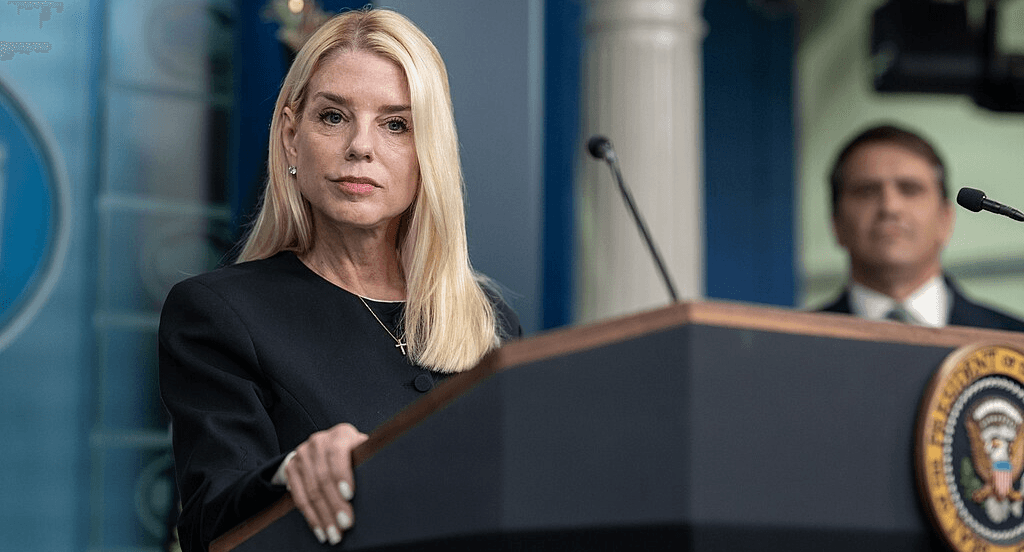
Attorney General Pam Bondi called the scheme a "brazen power grab that tramples on civil rights and mocks the democratic process," adding, "Governor Newsom's attempt to entrench one-party rule and silence millions of Californians will not stand." First Assistant U.S. Attorney Bill Essayli echoed, "The race-based gerrymandered maps passed by the California legislature are unlawful and unconstitutional." The DOJ seeks a permanent injunction barring use of the map in 2026 and future elections.
The case joins a Republican-led suit filed November 5 by Assemblymember David Tangipa (R-Fresno) and the California Republican Party, which alleges the map violates the state constitution's equal population and compactness rules. Tangipa, on the Assembly Elections Committee, testified against Prop 50 as a "partisan power grab." The DOJ's intervention adds federal weight, potentially fast-tracking review.
This mid-decade redistricting frenzy, rare since Reconstruction, began with President Trump's July 2025 push for Texas to redraw maps, gaining five Republican seats. Democratic states like California, New York, Illinois, and Maryland followed, targeting 15 GOP seats collectively. A Common Cause poll from October 2025 found 51% of Republicans, 70% of Democrats, and 60% of independents oppose partisan mid-decade changes. The Supreme Court's 2019 Rucho v. Common Cause ruling barred federal partisan gerrymandering claims, leaving racial challenges as the primary recourse.
Newsom's office dismissed the suit, stating, "These losers lost at the ballot box and soon they will also lose in court." California Secretary of State Shirley Weber defended the map as compliant, emphasizing compliance with the Voting Rights Act's Section 2 protections for minority voting power. A hearing is set for December 10, with experts predicting a lengthy appeal possibly reaching the Supreme Court by mid-2026, in time to influence the midterms.
The stakes are high: California's 52 seats, with Democrats holding 40 post-2024, could tip House control, where Republicans lead 220-215.
Like this article