FBI Significantly Undercounts Armed Civilians Stopping Active Shooters, CPRC Analysis Reveals
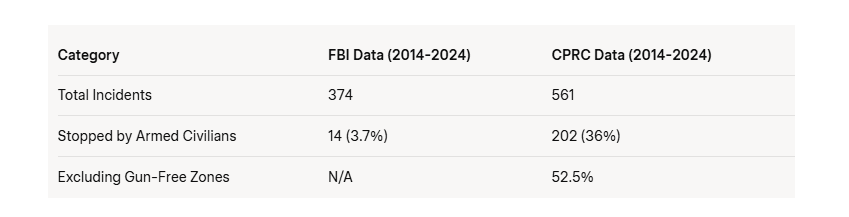
From 2014 to 2024, the FBI documented 374 active shooter events, claiming civilians halted just 14, or 3.7%. CPRC's independent analysis identified 561 incidents over the same period, with armed citizens stopping 202, or 36%.
A detailed review by the Crime Prevention Research Center (CPRC) exposes major flaws in FBI data on active shooter incidents, showing the bureau drastically underreports cases where armed citizens intervened to stop attacks.
From 2014 to 2024, the FBI documented 374 active shooter events, claiming civilians halted just 14, or 3.7%. CPRC's independent analysis identified 561 incidents over the same period, with armed citizens stopping 202, or 36%. Excluding gun-free zones, where firearms are prohibited, the rate rises to 52.5%, underscoring the effectiveness of lawful gun ownership in protecting lives.
CPRC attributes the discrepancies to systematic errors in FBI methodology. These include misclassifying private citizens as "security guards," failing to count interventions where shooters fled without being captured, and excluding events labeled as "domestic disputes" or "retaliation murders" even when they meet active shooter criteria. For the 2014-2023 subset, CPRC found the FBI missed 126 incidents and overlooked 39 where armed civilians prevented potential mass shootings.
Notable examples highlight these issues. In the December 2019 West Freeway Church of Christ shooting in White Settlement, Texas, parishioner Jack Wilson, a concealed carry holder, fatally shot the attacker after two were killed. The FBI categorized this as stopped by a security guard, ignoring Wilson's volunteer status. Similarly, a 2019 dental office attack in Colonial Heights, Tennessee, was dismissed as a domestic dispute, yet a permit holder subdued the shooter.
In the July 2022 Greenwood Park Mall incident in Indiana, 22-year-old Elisjsha Dicken neutralized a gunman who had killed three, drawing national attention but minimal media follow-up on armed citizen efficacy. CPRC President John Lott emphasized, "Of course, law-abiding citizens stopping these attacks are not rare. What is rare is national news covering it."
The FBI's reports aim to provide a "baseline understanding" but are not exhaustive, the bureau states. Critics argue this undercounting skews public debate toward stricter gun laws, downplaying Second Amendment benefits. Former DOJ official Theo Wold noted, "The cascading effect is incredibly deleterious. When the Bureau gets it so systematically wrong, it shapes the entire national debate."
Public sentiment aligns with CPRC findings. A 2022 Trafalgar Group poll showed 42% of voters view armed citizens as the best defense against mass shootings, compared to 25% favoring local police. Additional studies indicate armed civilians outperform law enforcement in stopping attacks, with fewer errors.
The FBI did not respond to requests for comment on CPRC's analysis. This revelation reinforces the vital role of armed self-defense in safeguarding communities against threats.
Like this article