U.S. Forces Strike TDA Narco Boat Off the Venezuelan Narco-Terror Boat in Bold Strike Against Drug Influx
The operation unfolded amid heightened U.S. naval presence in the region, following President Trump's deployment of three guided-missile destroyers and about 4,000 Marines to the Venezuelan coast in late August 2025.
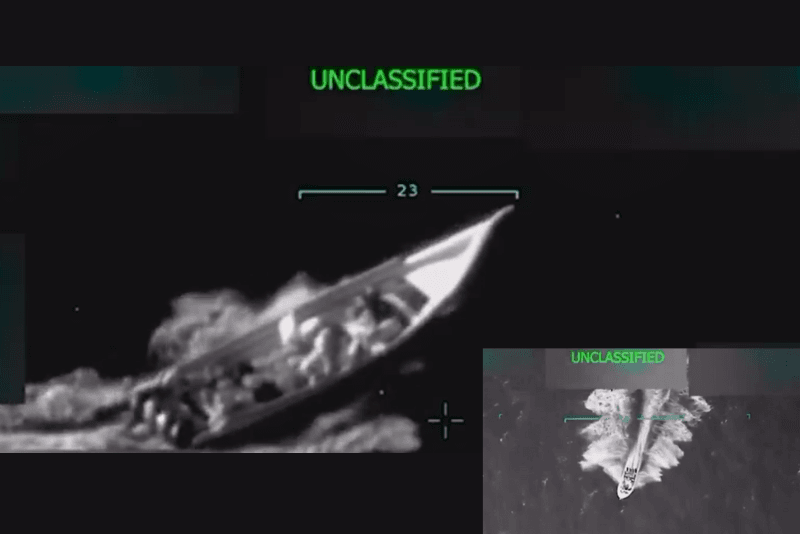
U.S. military forces executed a precision strike on September 2, 2025, sinking a speedboat laden with illegal narcotics off the Venezuelan coast in the southern Caribbean. The vessel, carrying 11 members of the notorious Tren de Aragua (TdA) gang, was obliterated in international waters, resulting in the deaths of all aboard and no casualties among U.S. personnel. President Trump announced the operation during an Oval Office briefing, fresh from a debrief by Joint Chiefs Chairman Gen. Dan “Raisin” Caine, emphasizing the boat's trajectory toward the United States and its cargo of drugs pouring in from Venezuela. "We just over the last few minutes, literally, shot out a boat, a drug-carrying boat — a lot of drugs in that boat," President Trump stated, adding, "We have a lot of drugs pouring into our country — coming in for a long time, and this came out of Venezuela, and coming out very heavily from Venezuela. A lot of things are coming out of Venezuela. We took it out."
Footage of the strike, released by the administration, captured the moment U.S. Navy assets unleashed firepower on the go-fast vessel, erupting in a brilliant explosion against the dark sea. President Trump shared the video on Truth Social, declaring TdA a designated Foreign Terrorist Organization operating under Nicolas Maduro's control and responsible for mass murder, drug trafficking, sex trafficking, and terror across the Western Hemisphere. "The strike occurred while the terrorists were at sea in International waters transporting illegal narcotics, heading to the United States," he posted, issuing a stark warning: "Please let this serve as notice to anybody even thinking about bringing drugs into the United States of America. BEWARE!" Secretary of State Marco Rubio confirmed the action on social media, underscoring its role in curbing the flow of deadly substances like fentanyl and cocaine that have ravaged American communities. This marks the first reported kinetic operation against a cartel vessel since President Trump authorized military involvement earlier in 2025, signaling a ramp-up in direct confrontations with narco-traffickers.
The operation unfolded amid heightened U.S. naval presence in the region, following President Trump's deployment of three guided-missile destroyers and about 4,000 Marines to the Venezuelan coast in late August 2025. This buildup prompted Maduro to rally millions of militia members, framing it as preparation for an impending invasion and declaring a "republic in arms" to repel any U.S. incursion. White House Press Secretary Karoline Leavitt dismissed Maduro's regime as an illegitimate "narco-terror cartel," while a senior administration source described the mission as "historic" in securing the hemisphere. The strike targeted a region notorious for cocaine exports, though specifics on the drugs aboard were not disclosed, highlighting Venezuela's role as a transit hub for South American narcotics bound for North America and Europe.
Tren de Aragua, the gang at the center of this incident, emerged from the depths of Venezuela's prison system, specifically Tocorón Prison in Aragua state, around 2013. Founded as a labor union for railway workers, it quickly morphed into a ruthless criminal syndicate under leader Héctor "Niño Guerrero" Guerrero Flores, who escaped during a 2023 government raid on the facility. TdA has since expanded transnationally, establishing footholds in the United States, Chile, Peru, Colombia, and beyond, fueled by Venezuela's mass exodus. The group engages in a wide array of illicit activities, including drug smuggling, human trafficking, extortion, kidnappings, and assassinations, often using extreme violence to dominate territories. In the U.S., TdA members have been linked to high-profile crimes, such as the murder of a Georgia nursing student and operations in cities like New York and Chicago, prompting ICE arrests and deportations targeting the gang. The administration's designation of TdA as a Foreign Terrorist Organization underscores its ties to Maduro's regime, which allegedly provides safe haven and operational support in exchange for loyalty and revenue from criminal enterprises.
Venezuela's dire situation under Nicolas Maduro has created fertile ground for groups like TdA to thrive. Maduro, who seized power in 2013 following Hugo Chavez's death, has presided over an economic catastrophe marked by hyperinflation, food shortages, and the collapse of oil production—the country's lifeline. Rigged elections, including the disputed 2024 vote, have solidified his grip despite widespread international condemnation, leading the U.S. to reject his legitimacy and impose sanctions. This turmoil has triggered one of the largest migration crises in history, with over 7.7 million Venezuelans fleeing since 2014, many crossing into the U.S. and carrying with them elements of organized crime. Maduro's regime faces U.S. indictments for narco-terrorism, with a $50 million bounty announced in August 2025 for his capture, accusing him of leading a cartel-like network that floods the U.S. with cocaine and fentanyl. Venezuelan officials deny these claims, but the country's strategic location and corrupt institutions make it a key node in global drug routes, exacerbating addiction epidemics and border insecurity in America.
The use of military assets in this strike reflects President Trump's broader strategy to militarize the war on drugs, a policy shift aimed at treating cartels as terrorist threats warranting lethal force rather than mere law enforcement targets. In August 2025, President Trump signed a secret directive authorizing the Pentagon to target Latin American drug networks, including airstrikes and special operations, bypassing traditional DEA-led efforts. This approach draws on historical precedents like operations in Colombia and Mexico, but escalates involvement by deploying warships and troops directly, potentially deterring traffickers through overwhelming power. Implications are profound: It could disrupt supply chains, reduce overdose deaths—over 100,000 annually from fentanyl alone—and assert U.S. dominance in the hemisphere. However, risks abound, including diplomatic fallout with nations like Venezuela, unintended civilian casualties, and the potential for cartels to adapt by going underground or retaliating through asymmetric warfare. Critics warn it may perpetuate endless conflicts without addressing root causes like demand in the U.S. or corruption abroad, echoing the mixed outcomes of past militarized campaigns that strengthened some groups while weakening others. For President Trump's administration, this strike serves as a proof of concept, promising more actions to protect American lives and sovereignty from foreign threats.
Like this article